

46 Adirondack High Peaks: Complete Hiking Guide
The 46 Adirondack High Peaks are among the most iconic mountain challenges in the eastern United States — a collection of summits scattered across the wild heart of New York's Adirondack Park. Hiking all 46 is a rite of passage for serious hikers, earning you the coveted title of Adirondack 46er.
What are the Adirondack High Peaks?
The High Peaks are a group of 46 mountain summits originally identified by brothers Robert and George Marshall, along with their guide Herbert Clark, who believed all 46 exceeded 4,000 feet in elevation. Over a seven-year period ending in 1925, the three became the first to climb all of them. Later surveys revealed that a handful actually fall short of 4,000 feet — but tradition held, and all 46 remain on the official list.
Today, the peaks are managed within the High Peaks Wilderness Area of Adirondack Park — the largest publicly protected area in the contiguous United States. The terrain ranges from well-worn trails to remote, trailless summits that require map, compass, and serious navigation skills.
Becoming an Adirondack 46er
The Adirondack Forty-Sixers Inc. is the official membership organization recognizing those who complete all 46 summits. Once verified, you receive your official 46er number and patch.
Completion must be reported in writing, by mail to the club historian — no online form, no email. It's a deliberate nod to the analog roots of a challenge that predates the internet by decades.
Pure Adirondacks
Gear Up for the High Peaks
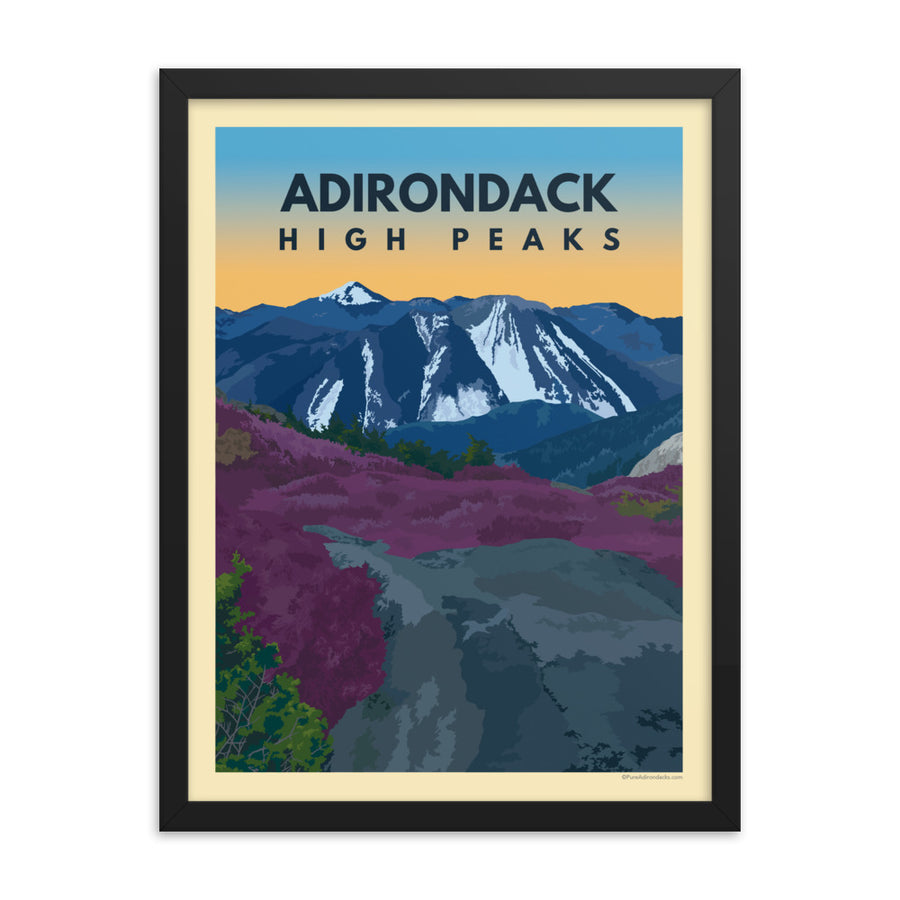
Hats, tees, and prints for those chasing summits and living the ADK life.
Where to start in the High Peaks
Every High Peak demands respect — solid fitness, proper gear, and good trail sense are baseline requirements. That said, some peaks are more approachable than others. These are good first targets.
The most climbed High Peak for good reason. Well-maintained trail, manageable round-trip under 5 miles, and an open rocky summit with sweeping 360° views.
Often paired with Algonquin, but manageable as a standalone day hike. Steep sections and exposed rock near the summit give you a real taste of High Peaks terrain.
Less technically demanding than its neighbors. Great Range views make it worth the effort, and it pairs naturally with other trails in the Marcy Dam area.
Less trafficked than Cascade but every bit as rewarding. Excellent Great Range views and a satisfying trail. Best once you have a peak or two under your belt.
Seasonal hiking guide
Conditions in the High Peaks vary dramatically by season. Know what you're walking into before you head out.
Peak season. Trails are in the best shape, weather is most predictable, and the days are long. Start early on popular peaks — crowds and parking fill fast. Black flies can be brutal through mid-July.
Spectacular foliage, thinning crowds, crisp air. Peak color hits the High Peaks in late September. Nights get cold fast — layers are essential and snow is possible on summits by mid-October.
A serious undertaking. Microspikes and snowshoes are mandatory, navigation is harder, conditions change rapidly. The reward — silent forests, rime-covered summits — is unlike any other season. Do not attempt without proper experience.
Trails are saturated and heavily impacted. The DEC regularly issues closures on high-elevation trails through Memorial Day weekend. Best left to lower-elevation hikes until conditions firm up.
Gear recommendations
The High Peaks demand respect and preparation. Here's what to have dialed in before you head out.
Stay on rock above treeline to protect fragile alpine vegetation. Pack out everything you pack in. Use designated campsites and lean-tos. The High Peaks see hundreds of thousands of visitors each year — every hiker's choices add up.
Planning your trip
Know before you go — access rules and campsite regulations in the High Peaks Wilderness are strictly enforced.
The Full List of 46 High Peaks
All 46 peaks ranked by elevation, each with a dedicated trail guide.
Showing all 46 peaks
| # | Mountain | Elevation (ft) |
|---|---|---|
1 |
Marcy | 5,344 |
2 |
Algonquin | 5,114 |
3 |
Haystack | 4,960 |
4 |
Skylight | 4,926 |
5 |
Whiteface | 4,867 |
6 |
Dix | 4,857 |
7 |
Gray | 4,840 |
8 |
Iroquois | 4,840 |
9 |
Basin | 4,827 |
10 |
Gothics | 4,736 |
11 |
Colden | 4,714 |
12 |
Giant | 4,627 |
13 |
Nippletop | 4,620 |
14 |
Santanoni | 4,607 |
15 |
Redfield | 4,606 |
16 |
Wright Peak | 4,580 |
17 |
Saddleback | 4,515 |
18 |
Panther | 4,442 |
19 |
Tabletop | 4,427 |
20 |
Rocky Peak Ridge | 4,420 |
21 |
Macomb | 4,405 |
22 |
Armstrong | 4,400 |
23 |
Hough | 4,400 |
24 |
Seward | 4,361 |
25 |
Marshall | 4,360 |
26 |
Allen | 4,340 |
27 |
Big Slide | 4,240 |
28 |
Esther | 4,240 |
29 |
Upper Wolf Jaw | 4,185 |
30 |
Lower Wolf Jaw | 4,175 |
31 |
Street | 4,166 |
32 |
Phelps | 4,161 |
33 |
Donaldson | 4,140 |
34 |
Seymour | 4,120 |
35 |
Sawteeth | 4,100 |
36 |
Cascade | 4,098 |
37 |
South Dix | 4,060 |
38 |
Porter | 4,059 |
39 |
Colvin | 4,057 |
40 |
Emmons | 4,040 |
41 |
Dial | 4,020 |
42 |
Grace Peak | 4,012 |
43 |
Blake Peak | 3,960 |
44 |
Cliff | 3,960 |
45 |
Nye | 3,895 |
46 |
Couchsachraga | 3,820 |
Common questions